



Laser Therapy for Heel Spurs: What Patients Should Know
Heel pain can continue even when an X-ray shows a heel spur. The spur may be an incidental finding, while the plantar fascia, fat pad, tendon, nerve, or another nearby structure is causing the discomfort. Laser therapy for heel spurs may be one non-invasive option when an evaluation suggests that irritated soft tissue is contributing to the problem.
Discuss your heel pain and laser therapy options
The goal is not to treat an image in isolation. It is to understand why your heel hurts, what activities are limited, and which options offer a reasonable balance of potential benefit, comfort, and recovery demands. This guide explains where Class IV laser therapy may fit, what it cannot do, and why candidacy should be individualized.
How Does an Evaluation Clarify Heel-Spur Pain?
Answer: Comprehensive Foot and Ankle Institute evaluates whether heel pain comes from the plantar fascia, fat pad, tendon, nerve, joint, bone, or more than one source. A heel spur on an X-ray does not identify the pain source by itself. That distinction helps Dr. Sutpal Singh decide whether Class IV laser therapy or another option is reasonable.
A heel spur is a bony projection that can appear on imaging. Its presence does not prove that it is the primary pain generator. Some people have a spur without symptoms. Other patients have pain caused by soft-tissue irritation or several overlapping conditions. A useful plan starts by separating the imaging finding from the complete clinical picture.
Symptoms can provide clues
During an evaluation, describe where the pain is located and when it is most noticeable. Pain with the first steps after rest can occur with plantar fascia irritation. Pain after running, prolonged standing, or a change in training may point toward an overload problem. Burning, tingling, swelling, bruising, or pain that travels beyond the heel may suggest a different or additional issue.
Also explain your activity demands, prior injuries, footwear, work requirements, and treatments. This history keeps the plan connected to daily life.
Examination and imaging work together
A physical examination may assess tenderness, alignment, ankle and toe motion, strength, walking mechanics, skin condition, and sensation. Comparing both feet can reveal differences that are not apparent on a scan. Imaging may confirm a spur or help investigate bone and joint concerns, but its purpose is to answer a clinical question. Spur size alone does not determine the severity of pain.
Key point: The key question is not always, “How large is the heel spur?” Instead, ask which tissue or movement pattern best explains the symptoms. A doctor can then select an appropriate next step, such as laser therapy, supportive care, another regenerative option, or a different evaluation.
Patients from Hoffman Estates, Schaumburg, Palatine, Arlington Heights, Barrington, South Barrington, Rockford, East Dundee, West Dundee, Rolling Meadows, and Elk Grove Village can learn more through the institute’s foot and ankle services. A regional evaluation can be useful when symptoms have continued despite earlier care.
How May Laser Therapy for Heel Spurs Support Soft Tissue?
Answer: Class IV laser therapy for heel spurs may be considered when an evaluation suggests that irritated soft tissue contributes to pain. At Comprehensive Foot and Ankle Institute, Dr. Singh selects treatment around the individual diagnosis and goals. Laser therapy is non-invasive and does not shave down, dissolve, or remove the bony spur.
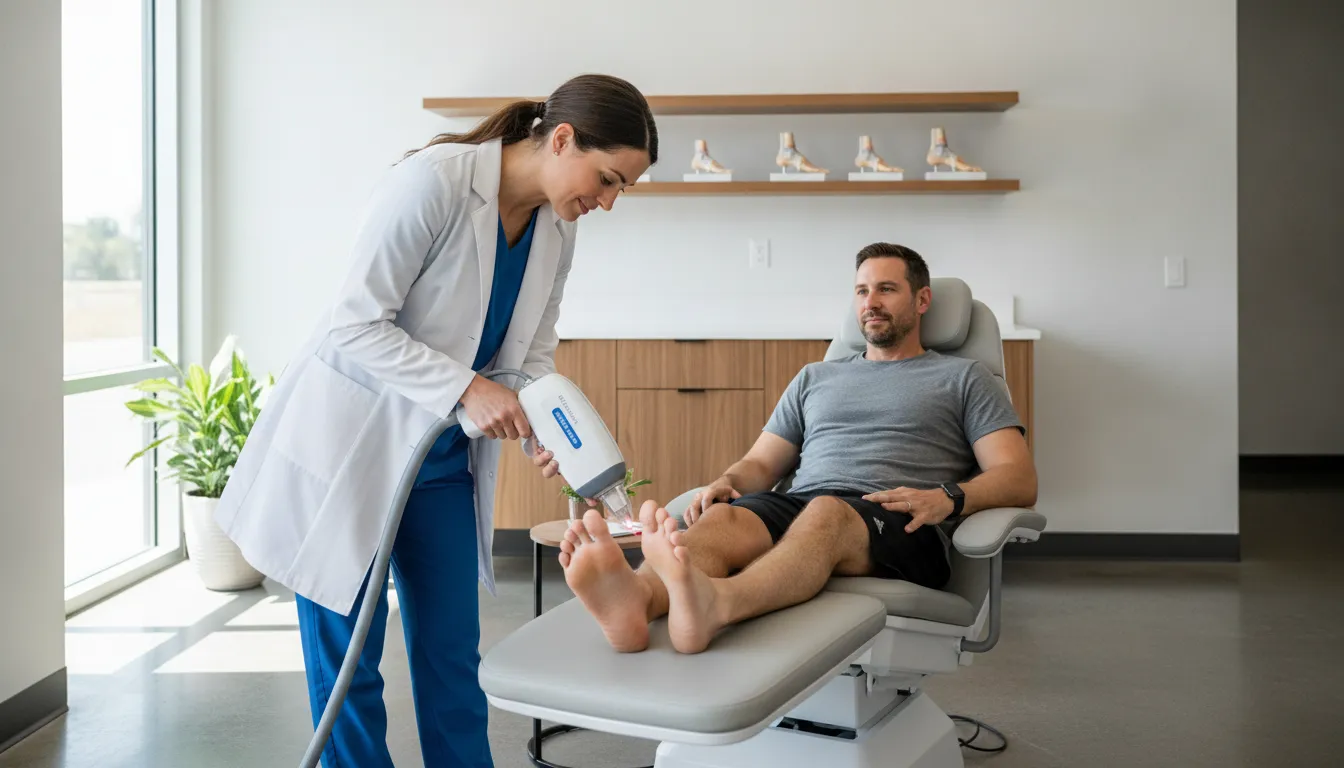
Laser therapy does not remove a heel spur. Class IV laser therapy directs light energy toward an area selected after examination. The intended role is to support the local tissue environment and help manage discomfort when soft-tissue irritation contributes to heel pain.
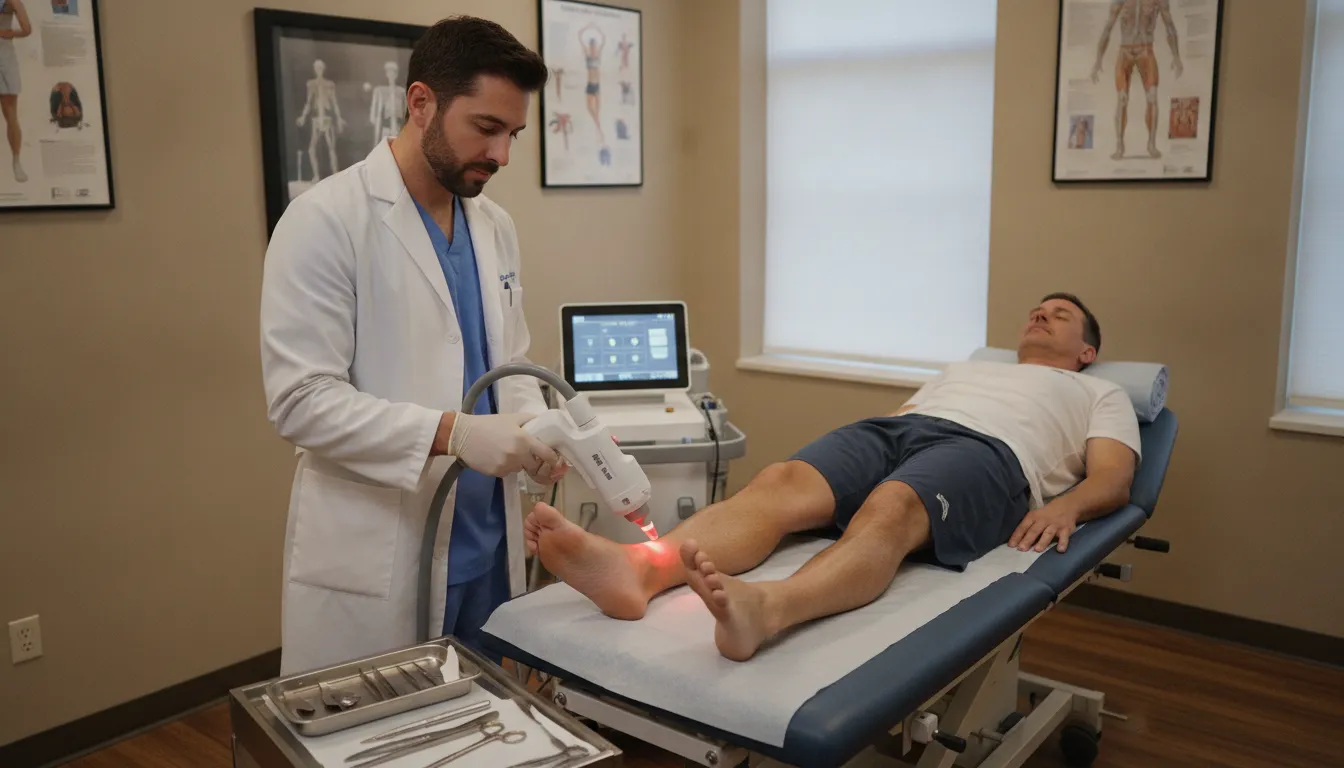
Photobiomodulation is the broader term used for therapeutic light approaches. In plain language, specific wavelengths may interact with cells in treated tissue and influence local biological activity. The treatment area, settings, and overall plan should be selected by a qualified clinician after an examination. The same protocol is not automatically appropriate for every foot or diagnosis.
Research has examined laser approaches for calcaneal spurs and other musculoskeletal conditions. One prospective randomized clinical study compared low-level laser therapy with extracorporeal shock wave therapy for calcaneal spur treatment. The study evaluated non-surgical modalities, not a way to remove bone. Read the PubMed comparison of laser and shock wave therapy. A separate review examined high-intensity laser therapy in musculoskeletal care. Review the PubMed research on high-intensity laser therapy.
Research findings require context because studies use different devices, schedules, and outcome measures. Published results do not predict exactly how one person will respond.
What this means for you: Laser therapy may be considered for the tissues contributing to heel pain. It is one part of treatment planning, not a guaranteed cure or a procedure that removes a spur.
Who May Consider Laser Therapy for Heel Spurs?
Answer: A potential candidate for laser therapy for heel spurs is identified by symptoms, examination findings, medical history, and treatment goals, not by an X-ray alone. Comprehensive Foot and Ankle Institute may discuss this non-invasive option with patients whose heel pain appears related to treatable soft-tissue irritation and whose goals fit the approach.
Laser therapy may be worth discussing when an evaluation suggests that irritated or stressed soft tissues are contributing to heel pain. It may also be relevant for a patient who wants to explore a non-invasive option before considering a more invasive procedure. Candidacy is individualized, and a heel spur without symptoms does not automatically require treatment.
Active adults may ask about laser therapy when pain affects walking, exercise, work, or sport. Patients with persistent or recurring symptoms may want a fresh review after trying footwear changes, activity adjustments, exercises, or other care. A prior treatment that did not help does not by itself prove that laser is appropriate. The clinician still needs to identify the pain source and determine whether the treatment’s purpose matches the problem.
Questions to bring to an evaluation
- What structure is most likely causing my pain?
- Does the heel spur appear related to my symptoms, or could it be incidental?
- What has already been tried, and how did my foot respond?
- Could laser therapy fit my activity goals and medical history?
- What other non-invasive or regenerative options should I understand?
- How will we decide whether the plan is helping?
Patients referred after podiatric or orthopedic care can bring prior records and imaging when available. Dr. Sutpal Singh, DPM, FACFAS, can review the history, examination findings, and goals before discussing whether Class IV laser therapy belongs in the plan. Seek prompt medical attention for significant swelling, weakness, skin changes, fever, numbness, or pain that is worsening quickly.
Key point: A potential candidate is defined by the diagnosis and treatment goals, not by the X-ray alone. The plan should account for medical history, medications, sensation, activity demands, and the possibility that another condition needs attention first.
Talk with Dr. Singh about your heel-pain treatment plan
What Can a Personalized Heel-Pain Plan Include?
Answer: A personalized heel-pain plan may combine Class IV laser therapy with activity guidance, footwear changes, mobility work, strengthening, shock wave therapy, or another treatment when appropriate. Dr. Singh connects the recommendation to the patient’s examination, health history, work or sport demands, and response over time rather than prescribing a preset series of visits.
A plan should begin with the patient rather than a predetermined series of laser visits. At Comprehensive Foot and Ankle Institute, Dr. Singh’s regenerative approach may include Class IV laser therapy when the findings and goals support it. Other measures may also be discussed, such as activity modification, footwear changes, mobility work, strengthening guidance, shock wave therapy, or additional evaluation.
For an active patient, the goal may be to reduce aggravating loads while preserving safe movement. The plan should reflect the tissues involved, response to care, and work or exercise demands.
Laser therapy and shock wave therapy are different approaches. Research comparing them does not make them interchangeable or universally effective. The choice may depend on the suspected tissue, symptom duration, prior response, tolerance, and overall plan. In selected cases, another regenerative option or a minimally invasive procedure may be discussed.
Follow-up gives the clinician a chance to review pain, walking, activity tolerance, and new symptoms. The plan may continue, change, or be reconsidered. Function is more useful to track than an X-ray finding.
Learn more about the physician-led approach on the Our Doctor page and the institute’s Class IV laser therapy article. The practice uses a concierge model with no double-booking and personalized attention, so the evaluation can focus on your questions and goals.
What Are Realistic Expectations for Laser Therapy for Heel Spurs?
Answer: Laser therapy for heel spurs is generally planned around the suspected pain source, symptom history, health factors, and activity goals. There is no universal number of visits or guaranteed result. Progress should be reviewed through comfort, walking, and function, with Dr. Singh adjusting the plan when the response does not match expectations.
Laser therapy is generally delivered as an in-office, non-invasive treatment. The clinician directs the device over the area selected after evaluation. Some people notice warmth or a mild sensation, while others notice little during the session. Tell the clinician if the treatment feels uncomfortable. The approach and treatment area may be adjusted when clinically appropriate.
How many sessions might be needed?
There is no fixed number of sessions that applies to every patient. Visit frequency depends on the suspected pain source, symptom duration, relevant health factors, activity goals, and response to care. A clinician may recommend an initial plan and then reassess instead of promising a fixed number of treatments.
- At the first visit: Expect a review of symptoms, history, examination findings, and treatment goals.
- During treatment: The laser is directed toward the area identified in the plan, without an incision.
- Between visits: Follow activity and footwear guidance tailored to your symptoms.
- At reassessment: Discuss comfort, walking, function, and whether the next step still makes sense.
Does laser therapy remove a heel spur?
No. Laser therapy does not remove the bony growth. It may be considered to support surrounding tissues when those tissues contribute to pain. If a structural problem remains the main source of symptoms, the clinician may discuss other options. The treatment plan should match the problem being treated.
Does laser therapy guarantee relief?
No treatment can guarantee a particular result for every patient. A response may vary with the diagnosis, tissue involved, symptom duration, activity demands, and other health factors. Ask how improvement will be measured and when the plan should be reconsidered if symptoms do not change as expected.
What this means for you: Set expectations around comfort and function, not around erasing a spur on an image. A gradual response or a change in plan does not mean that the evaluation was unnecessary. It means care should remain responsive to evidence from your foot.
How Does Laser Compare With Other Heel-Pain Options?
Answer: Laser therapy, supportive care, shock wave therapy, and procedures serve different purposes. At Comprehensive Foot and Ankle Institute, the choice depends on the tissue involved, symptom pattern, prior care, health history, and activity goals. Comparing options can clarify tradeoffs without assuming that one treatment works for every patient.
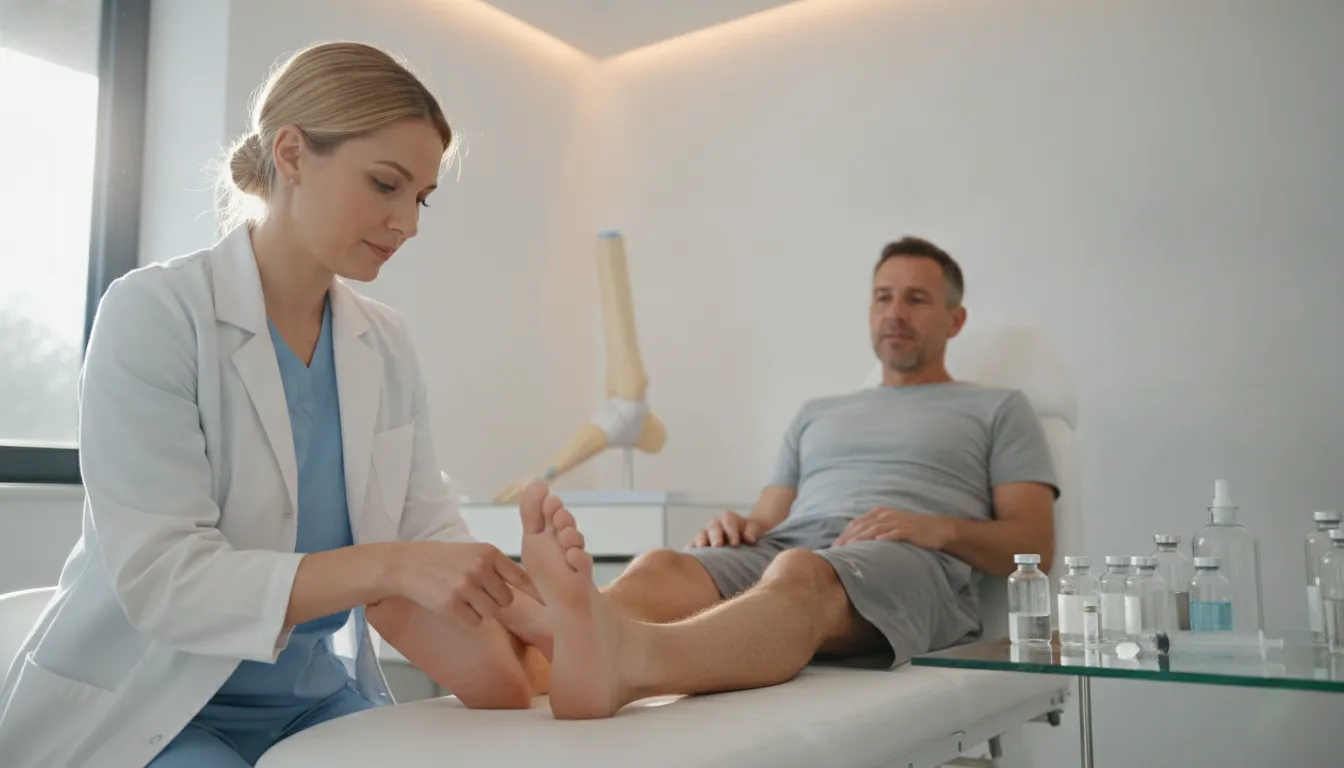
Laser therapy is one possible component of care, not an automatic replacement for every other option. A doctor may compare it with supportive measures, shock wave therapy, or a procedure based on the diagnosis and goals. Treatment should be selected after an examination, not from a list of procedures alone.
| Option | Possible role | Important expectation |
|---|---|---|
| Laser therapy | Non-invasive tissue-focused care when findings support it. | Does not remove the spur, and response varies. |
| Supportive care | Reduce mechanical stress through individualized activity, footwear, mobility, or strengthening guidance. | Consistency and follow-up may be needed. |
| Shock wave therapy | Another non-invasive modality that may be considered for selected musculoskeletal presentations. | It is different from laser and may cause temporary treatment discomfort. |
| Procedure | Address a structural problem when clinically appropriate. | Invasiveness and recovery depend on the diagnosis and procedure. |
Key point: Treatment selection should follow the diagnosis. Laser may fit one patient, while supportive care, shock wave therapy, another regenerative option, or a procedure may fit another. A comparison is useful when it helps you understand tradeoffs rather than pushing a single answer.
Patients can review patient testimonials for context about the practice. Another person’s experience cannot predict an individual medical outcome, so use testimonials as background rather than as a promise.
Why Does Doctor-Led Planning Matter in Hoffman Estates?
Answer: Doctor-led planning connects symptoms, examination findings, health history, and activity goals before selecting a treatment. In Hoffman Estates, Dr. Sutpal Singh’s concierge model emphasizes individualized attention and a direct discussion of potential benefits, limitations, alternatives, and follow-up for patients from the northwest Chicago suburbs.
Heel pain is easier to plan for when someone considers the whole person, not only the imaging result. Dr. Singh is a third-generation physician with more than 30 years of experience and advanced credentials. His practice serves patients from Hoffman Estates and northwest Chicago suburbs including Schaumburg, Palatine, Arlington Heights, Barrington, South Barrington, Rockford, East Dundee, West Dundee, Rolling Meadows, and Elk Grove Village.
The concierge model provides personalized attention without double-booking. This format can help patients compare non-invasive options and discuss a complicated history. The objective is a clear discussion of diagnosis, options, limitations, and next steps. No treatment should be promised before an examination.
For questions about laser therapy for heel spurs, call the office at (847) 310-1600 or use the contact page. The office number is provided as visible text only, without a telephone link.
Contact Comprehensive Foot and Ankle Institute about your heel pain
Frequently Asked Questions
Does laser therapy really work for heel spurs?
Laser therapy may help some patients manage soft-tissue discomfort associated with heel pain, but it does not remove a heel spur and cannot guarantee relief. The likely pain source, health history, activity goals, and response to care all influence whether it is reasonable to consider.
How many laser therapy sessions are needed for heel spurs?
There is no fixed number for every patient. Visit frequency depends on diagnosis, history, response, and goals. The clinician can recommend an initial plan and reassess comfort and function before continuing or changing care.
Is laser therapy for heel spurs painful?
Laser therapy is non-invasive. Some patients notice warmth or a mild sensation, while others notice little during treatment. Tell the clinician if you are uncomfortable so the approach can be reviewed and adjusted when appropriate.
What is the success rate of laser therapy for heel spurs?
A single success rate cannot predict an individual result. Studies use different devices and protocols, and patient factors vary. Ask how progress will be measured and what alternatives should be considered if your symptoms do not change as expected.
Can laser therapy remove a heel spur without surgery?
No. Laser therapy does not remove the bony growth. It may be considered when surrounding soft tissue contributes to pain. If the spur or another structural condition is clinically important, a doctor can explain other appropriate options.