



Foot pain from metatarsal conditions can severely limit your life. Minimally invasive metatarsal surgery offers a modern path to relief. This advanced approach avoids large incisions and screws, letting you walk immediately after the procedure.
Minimally invasive metatarsal surgery, as performed by Dr. Sutpal Singh, DPM, FACFAS, is a precise, minor in-office procedure to correct conditions like metatarsalgia, metatarsal fractures, and crossover toe. Using tiny 3mm incisions, specialized surgical instruments reshape and realign the bones without the need for plates, screws, or internal hardware. This dramatically reduces soft tissue damage and recovery time. The procedure is performed under local anesthesia, allowing patients to walk out of the clinic and begin weight-bearing recovery immediately. This approach minimizes scarring, discomfort, and disruption to daily life, offering a gentler alternative to traditional open surgeries and a quicker return to active living.
Many people endure metatarsal pain, unaware that effective, less invasive options exist. Our path to understanding begins with the fundamentals of this advanced surgical approach.
What Is Minimally Invasive Metatarsal Surgery?
Understanding Minimally Invasive Metatarsal Osteotomy (DMMO)
Minimally invasive metatarsal surgery, often called DMMO (Distal Minimally Invasive Metatarsal Osteotomy), is a modern way to fix issues with the metatarsal bones in your foot. This method uses very small cuts, typically only 3mm long. A special tool called a burr goes through this small opening to carefully reshape the bone. The goal is to shorten and lift the metatarsal bone, helping to correct common foot problems like hammertoes or bunions.
A Hardware-Free Approach
A key difference with DMMO is that it avoids internal hardware. Unlike traditional surgeries that might use screws or plates, DMMO relies on the body’s natural healing process. After the bone is reshaped, your ligaments and other soft tissues hold everything in its new position. This can mean less scarring and a quicker recovery for some patients. Dr. Singh, for example, gained international training in these techniques in Greece and Russia.
Benefits of Minimally Invasive Techniques
Using these small incisions and no hardware means less trauma to the surrounding tissues. Patients often experience less pain and swelling compared to open surgery. This also lowers the risk of complications tied to internal fixations. It’s a precise approach designed for effective correction with minimal disruption. Learn more about hammertoe surgery without hardware.
Common Metatarsal Conditions That Benefit from Minimally Invasive Surgery
Metatarsalgia: Relief from Forefoot Pain
Metatarsalgia describes pain and inflammation in the ball of your foot. It often occurs when the metatarsal bones, which connect your toes to your ankle, become misaligned or stressed. Traditional surgery may involve larger incisions, longer recovery, and more scarring. Minimally invasive surgery (MIS) uses small cuts to address the cause of the pain, often leading to quicker healing and less discomfort. Learn more about metatarsalgia foot pain relief through modern treatments.
Crossover Toe: Correcting Toe Drift
Crossover toe is a condition where one toe begins to drift and eventually overlaps an adjacent toe. This often happens due to a tear in the soft tissues that hold the toe in place. If left untreated, it can cause severe discomfort and make wearing shoes difficult. MIS techniques allow surgeons to repair the ligament and realign the toe with minimal disruption to the surrounding tissues. This can help restore proper toe alignment and reduce pain.
Metatarsal Fractures: Precise Healing Options
Fractures of the metatarsal bones can result from direct injury, repetitive stress, or conditions that weaken bone. While some fractures heal with rest, others require surgical intervention to ensure proper alignment and function. Minimally invasive approaches for metatarsal fractures use tiny incisions to stabilize the bone. This method often lowers the risk of infection and promotes faster recovery compared to open surgery. For more information on such procedures, see resources from the National Institutes of Health.
How Minimally Invasive Metatarsal Surgery Works: Step by Step
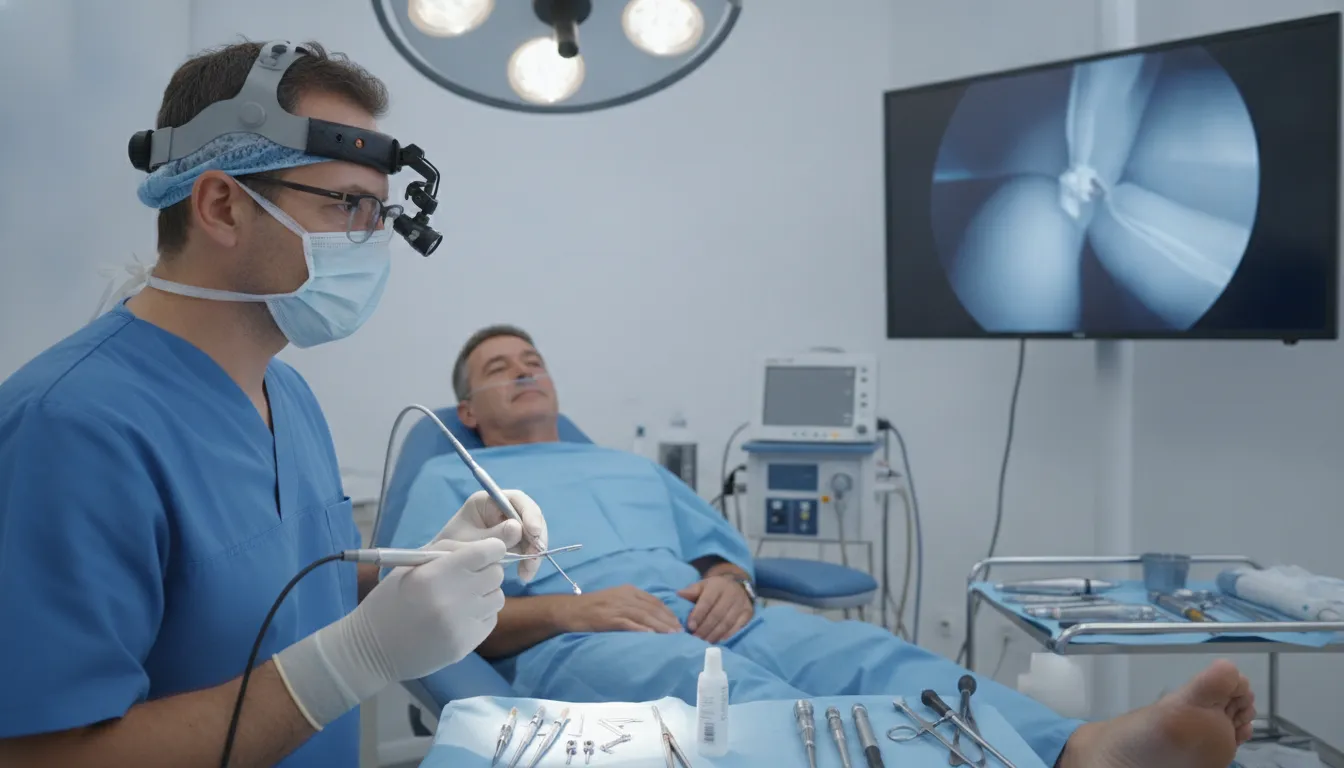
Minimally invasive metatarsal surgery offers a precise way to correct foot issues without a large incision. This procedure avoids hospitalization and general anesthesia, keeping you comfortable and recovering quickly. You will arrive at the office, where local anesthesia will numb your foot. This ensures you feel no pain during the surgery.
The Incision and Bone Work
The surgeon makes a tiny “poke hole” incision on top of your foot. This small opening is enough for the specialized tools. Under X-ray guidance, a minimally invasive burr precisely cuts the bone. This allows for careful realignment and shortening of the metatarsal bone.
- Arrival and Anesthesia: You check in for your appointment. Your foot is numbed with local anesthesia, ensuring a pain-free experience.
- Tiny Incision: A small “poke hole” is made on the top of your foot. This allows access for the surgical tools.
- Precise Bone Cut: Under X-ray guidance, a specialized burr makes a precise cut in the metatarsal bone.
- Realignment: The bone is carefully realigned and shortened as needed to correct the foot issue.
- Natural Stabilization: No hardware like screws or plates is needed. Your body’s ligaments naturally hold the corrected bone in place.
- Immediate Post-Op Care: The incision is bandaged. You can immediately walk in a special post-operative shoe.
- RED:VIVE Therapy: Dr. Singh uses RED:VIVE red light therapy on all post-operative patients. This helps with healing and reduces discomfort.
Quick Recovery and Support
Because the procedure is minimally invasive, recovery is often faster than traditional surgery. The small incision and lack of hardware mean less trauma to the surrounding tissues. Following your surgeon’s post-operative instructions is key for the best outcome.
Minimally Invasive vs. Traditional Metatarsal Surgery: Key Differences
When considering metatarsal surgery, it is important to understand the differences between minimally invasive surgery (MIS) and traditional open approaches. The Comprehensive Foot and Ankle Institute prefers the MIS approach for its clear benefits. This modern technique offers a less disruptive path to recovery.
Minimally invasive surgery uses small incisions, reducing the impact on surrounding tissues. This often leads to a quicker return to normal activities. In contrast, traditional surgery involves larger incisions and a more intensive recovery period. The table below highlights the key distinctions.
| Aspect | MIS Approach | Traditional Approach |
|---|---|---|
| Incision Size | 3mm | 2-3 inches |
| Anesthesia | Local | General |
| Hospital Stay | None | Overnight |
| Hardware | None needed | Screws, plates |
| Weight-Bearing | Immediate | Non-weight-bearing for 6-8 weeks |
| Recovery Shoe | 2-4 weeks | Boot or cast for 6-8 weeks |
| Return to Sneakers | 2-4 weeks | 8-12 weeks |
| Infection Risk | Lower due to small incision | Higher |
| Scarring | Minimal | Significant |
The MIS approach offers several advantages, including less pain and a lower risk of infection due to the smaller incisions. Patients can often bear weight immediately and return to regular footwear much sooner. This makes MIS a preferred option for many individuals seeking metatarsal correction.
At the Comprehensive Foot and Ankle Institute, we focus on methods that support a faster, smoother recovery. Our commitment to minimally invasive techniques reflects our goal to provide effective care with less interruption to your life. For more details on what to expect, read about our bunion surgery recovery guide.
Recovery: What Patients Can Expect After Minimally Invasive Metatarsal Surgery
Immediate Post-Surgery Experience
After minimally invasive metatarsal surgery, patients can often walk immediately. You will wear a protective post-operative shoe for approximately 2 to 4 weeks. This shoe helps support your foot and protect the surgical site during the initial healing phase.
Managing swelling is crucial for a smooth recovery. Elevating your foot, especially for the first 7 days, is highly recommended. This helps reduce discomfort and promotes faster healing. Follow your surgeon’s specific instructions for elevation and weight-bearing.
Returning to Daily Activities
Many patients with sedentary jobs can return to work within about 2 weeks. If your job requires more active movement or standing, expect to wait around 4 weeks before returning. The smaller incision and less tissue disruption typical of minimally invasive procedures often result in less post-operative pain compared to traditional surgery.
Our practice offers advanced regenerative therapies to support your recovery. Treatments like Class IV laser therapy, SoftWave shock wave therapy, and red light therapy can help accelerate healing. These therapies also work to reduce inflammation around the surgical area.
Long-Term Healing and Support
While patients typically return to wearing sneakers within a few weeks, full bone remodeling takes longer. This process can continue for up to 6 months. During this time, the bones continue to strengthen and adapt.
We provide comprehensive guidance throughout your recovery journey. This includes advice on exercises, shoe choices, and managing any residual discomfort. Our goal is to ensure you achieve the best possible long-term outcome.
Why Choose Dr. Sutpal Singh for Minimally Invasive Metatarsal Surgery?
When considering surgical correction for metatarsal pain or deformities, the skill, credentials, and philosophy of your surgeon are paramount. Dr. Sutpal Singh, DPM, FACFAS, offers a rare combination of elite international surgical training and a compassionate, patient-centered concierge approach that sets him apart as the premier podiatric surgeon in the northwest Chicago suburbs.
Unrivaled International Credentials and Training
Dr. Singh is a third-generation physician with over 30 years of clinical experience. He has pursued advanced, specialized training at some of the world’s most prestigious medical institutions:
- Russian Ilizarov Scientific Centre (Kurgan, Russia): Dr. Singh completed multiple fellowships at this world-famous facility, mastering complex deformity corrections and reconstructive techniques that very few U.S. surgeons are trained to perform.
- Minimal Incision Mini-Fellowships: He completed four mini-fellowships in Greece and Russia, specifically focused on minimal-incision surgical techniques for reconstructive and trauma podiatry.
- Duke University Medical Center: Advanced training in flap plastic surgery for wound reconstruction and complex tissue transfers.
- Columbia Presbyterian University: Certification in microvascular surgery.
- Johns Hopkins University: Advanced training in peripheral nerve surgery under the pioneer of lower extremity nerve decompression, Dr. A. Lee Dellon.
Rare Double Board Certification
Dr. Singh holds a rare double board certification from the American Board of Foot and Ankle Surgery:
- Board Certified in Reconstructive Rearfoot and Ankle Surgery
- Board Certified in Foot Surgery
This dual board certification reflects his mastery of both simple and highly complex reconstructive lower extremity procedures, ensuring patients receive the highest standard of surgical safety and precision.
A Personalized Concierge Approach to Care
At Comprehensive Foot and Ankle Institute, we refuse to treat patients like a “pack of cattle.” Dr. Singh operates under a personalized concierge model designed to respect your time and provide exceptional, focused care:
- No Double-Booking: Your appointment time is reserved exclusively for you.
- Minimal to No Wait Times: We structure our schedule so you are seen promptly by the doctor.
- Doctor-Led Attention: Dr. Singh spends dedicated time explaining your diagnosis, walking you through your customized treatment plan, and answering every question you have about minimally invasive metatarsal surgery.
Whether you are seeking relief in Hoffman Estates, Schaumburg, Barrington, or Arlington Heights, Dr. Singh is dedicated to helping you reclaim your active lifestyle, living by the philosophy that “Life is Motion and Motion is Life.”
Frequently Asked Questions About Minimally Invasive Metatarsal Surgery
Is metatarsal surgery considered a major surgery?
Traditional open metatarsal surgery is a significant procedure requiring general anesthesia, large incisions (2 to 3 inches), metal screws or plates, and a long non-weight-bearing recovery period of 6 to 8 weeks. In contrast, minimally invasive metatarsal surgery (such as DMMO) is an advanced, minor in-office procedure. It is performed under local anesthesia through a tiny 3mm “poke hole” incision, requires no internal hardware, and allows patients to walk out of the clinic immediately after the procedure.
How painful is minimally invasive metatarsal surgery?
Because minimally invasive metatarsal surgery causes far less trauma to the surrounding skin, muscles, and soft tissues than traditional open surgery, post-operative pain and swelling are significantly reduced. Most patients require only mild, over-the-counter anti-inflammatories rather than strong prescription narcotics. Dr. Singh also integrates advanced post-operative therapies, such as RED:VIVE red light therapy and Class IV laser treatments, to further accelerate healing and minimize discomfort.
Can I walk immediately after minimally invasive metatarsal surgery?
Yes. One of the greatest advantages of the minimal-incision approach is that patients can walk immediately after the procedure. You will wear a protective post-operative shoe for 2 to 4 weeks to protect the foot while the bone heals. This eliminates the need for casts, knee scooters, or 6 to 8 weeks of strict non-weight-bearing recovery associated with traditional surgery.
What is the difference between DMMO and a traditional Weil osteotomy?
A traditional Weil osteotomy requires a large surgical exposure of the metatarsophalangeal joint, a long incision, and the permanent insertion of metal screws or plates to hold the cut bone in place. This can lead to hardware irritation, scar tissue, and joint stiffness. Distal Minimally Invasive Metatarsal Osteotomy (DMMO) is performed through a tiny 3mm incision under X-ray guidance. The bone is cut with a specialized burr and allowed to self-align naturally without screws or plates, preserving joint mobility and dramatically reducing stiffness.
Do I need physical therapy after minimally invasive metatarsal surgery?
While most patients recover excellent joint mobility and function on their own thanks to the minimal tissue disruption of the MIS technique, some patients benefit from a brief course of physical therapy. Simple home exercises to bend and flex the toes are typically sufficient to restore full range of motion. Dr. Singh will customize your post-operative recovery plan based on your individual healing progress.
Reclaim Your Mobility Pain-Free
If you are struggling with chronic ball-of-foot pain, metatarsalgia, crossover toe, or a metatarsal fracture, you don’t have to face the risks and long recovery of traditional open surgery. Minimally invasive metatarsal surgery offers a safe, in-office, no-hardware path back to your active lifestyle.
Schedule a personalized consultation with double board-certified podiatric surgeon Dr. Sutpal Singh at the Comprehensive Foot and Ankle Institute today. Discover how our concierge care and advanced regenerative treatments can get you back on your feet quickly and comfortably.